Authors: Xun LI丨Bo ZHENG丨Song HONG[1]
The past month has been an active one for the stablecoin industry and the cryptocurrency industry as a whole:
On May 5, the Stablecoin Transparency and Accountability for a Better Ledger Economy Act (the "STABLE Act"), which is intended to establish a regulatory framework for stablecoins in the United States, was listed as No.68 on the calendar of the U.S. House of Representatives and was ready to be considered by the full House of Representatives.
On May 30, the Stablecoins Ordinance was officially promulgated in Hong Kong Special Administrative Region ("Hong Kong"), clearing the way for the issuance of stablecoins in Hong Kong. A number of leading fintech companies publicly announced their participation in the market in preparation for licences application for regulated stablecoin activities (for more details on the Hong Kong's Stablecoins Ordinance, see our previous article 汉坤 • 观点 | 香港立法会通过《稳定币条例草案》的影响与机遇).
On June 6, Circle, the issuer of the world's second-largest stablecoin, USDC, completed its public listing on the New York Stock Exchange, becoming the second large cryptocurrency company to join the U.S. stock market since the cryptocurrency exchange Coinbase was listed on the NASDAQ in 2021. As of June 16, Circle's latest market capitalization was nearly $30 billion.
On June 12, the progress of the Guiding and Establishing National Innovation for U.S. Stablecoins Act (the "GENIUS Act") made another significant breakthrough, which put an end to the debate in the Senate. The GENIUS Act is about to proceed to a vote by the full Senate.
Among the above significant events, the fate of the GENIUS Act and the STABLE Act (collectively referred to as the "U.S. Stablecoin Acts") in the U.S. Congress has attracted the most attention. In this article, we will focus on the change in the U.S. government's regulatory stance on the cryptocurrency industry, the main contents of the two bills and the latest legislative progress, and analyze the far-reaching impact of the U.S. Stablecoin Acts on the stablecoin industry.
Current regulatory stance of the U.S. government on the cryptocurrency industry
Since taking office, U.S. President Donald Trump has taken the following main supportive measures for the cryptocurrency industry, which departs from the more prudent regulatory attitude of his predecessor Joe Biden's administration:
On January 24, 2025, President Trump signed an Executive Order on "Strengthening American Leadership in Digital Financial Technology", establishing the President's Working Group on Digital Asset Markets, which will propose a federal regulatory framework to regulate the issuance and operation of cryptocurrencies in the United States (including stablecoins), explore the establishment of cryptocurrency reserves, and impose a total ban on central bank digital currencies (i.e., CBDCs);
On March 6, 2025, President Trump signed an executive order to establish a Strategic Bitcoin Reserve. Under the order, the federal government longer sell up to 200,000 bitcoins in the future, but will not longer acquire any additional assets for the reserve;
On March 7, 2025, Trump held the first Crypto Summit at the White House, expressing his support for the development of cryptocurrencies represented by Bitcoin and planning to promote bills on U.S. stablecoins before the August congressional recess, namely the GENIUS Act and the STABLE Act;
On May 12, 2025, Paul S. Atkins, who is close to cryptocurrencies, was appointed Chairman of the U.S. Securities and Exchange Commission (SEC). At the SEC's cryptocurrency roundtable, in addition to announcing that the SEC would no longer carry out "special enforcement" actions against cryptocurrencies, it also made clear that it would establish a regulatory framework for cryptocurrencies.
Although most of these measures have already been implemented, because the GENIUS Act and the STABLE Act involve congressional legislation, they need to be passed by the U.S. Senate and the U.S. House of Representatives, respectively, before they can be signed into law. These two bills have also become the key to determining the U.S. regulatory stance on stablecoins.
Comparing key provisions of the U.S. Stablecoin Acts
With respect to their legislative objectives, both the GENIUS Act and the STABLE Act aim to establish a regulatory framework for the U.S. dollar stablecoins and support the issuance of dollar-denominated assets (highly liquid, low-risk assets, such as U.S. Treasury bonds, U.S. money market funds, etc.) as a reserve asset, which is intended to further consolidate and expand the global influence of the U.S. dollar.
The U.S. Stablecoin Acts are generally similar in terms of the object of their legislation. Both bills define payment stablecoins as a digital assets for use in payments or settlements that are pegged to a fixed currency value and expressly exclude them as a security, commodity, or product of an investment company. Specifically, both bills would specifically exclude payment stablecoins from the regulatory framework by amending existing securities regulations (such as the Investment Company Act of 1940, the Securities Act of 1933, the Securities Exchange Act of 1934, and the Securities Investor Protection Act of 1970, etc.).
However, the two U.S. Stablecoin Acts are sponsored by different members of Congress. While much of their content is derived from the compliance standards for stablecoins already in the market, they differed significantly on a number of key issues such as the regulatory model, issuer qualifications, foreign issuers – specifically with respect to Tether, currently the largest offshore stablecoin issuer, whose corporate structure, according to public information, involves entities registered in a number of offshore finance centers.
Below, we have set out the key regulatory highlights as reflected in the most current text of each of the U.S. Stablecoin Acts:
Main content |
GENIUS Act |
STABLE Act |
Regulatory model |
Dual federal and state regulatory framework, under which issuers with total offerings over $10 billion are subject to federal regulation and issuers under $10 billion may opt for state regulation, provided that the state regulatory regime is "substantially similar" to the federal framework |
Concentrates regulatory authority primarily in the federal agencies; state regulators able to participate only if their regulatory regime has been certified by the Treasury Department as meeting or exceeding federal standards |
Issuer qualification |
Less restrictive issuing eligibility requirements adopted:
|
More restrictive issuing eligibility requirements adopted:
|
Foreign issuers |
More restrictive foreign issuer regulatory requirements adopted so that only issuers licensed in the United States may issue payment stablecoins in the United States |
Less restrictive foreign issuer regulatory requirements adopted; does not require licensed wholesale depository institutions to be registered in the United States; allows foreign stablecoins to operate if the Secretary finds that the foreign issuer has a regulatory regime comparable to the Act's requirements and the foreign issuer agrees to be subject to the United States' reporting and inspection requirements |
Reserve assets |
Support by the issuer of reserve assets in a ratio of at least 1:1, the types of assets are limited to: (1) U.S. currency or Federal Reserve Bank accounts (2) Demand deposits at protected depository institutions (3) U.S. Treasury bills, notes or bonds (remaining maturities or issues of 93 days or less) (4) Proceeds received under repurchase agreements backed by Treasury bills with maturities of 93 days or less (5) Reverse repurchase agreements: taking Treasury bills, notes or bonds as collateral overnight and meeting specified conditions, and (6) Shares of U.S. money market funds (7) Other federally issued assets with comparable liquidity approved by the regulator (8) The above assets in tokens, subject to all applicable laws and regulations |
Support by the issuer of reserve assets in a ratio of at least 1:1, the types of assets are limited to: (1) U.S. currency or Federal Reserve Bank accounts (2) Demand deposits of a protected deposit institution or approved foreign deposit institutions (3) U.S. Treasury bills, notes or bonds (remaining maturities or issues of 93 days or less) (4) Repurchase agreements with the issuer of payment stablecoins as the seller of securities or reverse repurchase agreements with the issuer of payment stablecoins as the purchaser of securities maturing overnight and backed by Treasury bills with maturities of 93 days or less and subject to certain conditions (5) Shares of U.S. money market funds |
Interest payments |
Not expressly limited |
Expressly prohibits interest or interest payments to stablecoin holders |
Endogenously collateralized stablecoins (i.e., algorithmic stablecoins) |
Does not impose a direct ban, but rather requires the Treasury Department to complete an algorithmic stablecoin study within 365 days of enactment and to develop policy based on the results of the study |
Imposes a 2-year ban entirely on new algorithmic stablecoins, except for algorithmic stablecoins that exist as of the effective date of the Act |
Recent legislative developments regarding the U.S. Stablecoin Acts
Currently, the GENIUS Act has passed a key procedural vote during debate in the U.S. Senate, with strong bipartisan support; the STABLE Act remains before the full U.S. House of Representatives (see the chart below for recent legislative developments and subsequent legislative milestones).
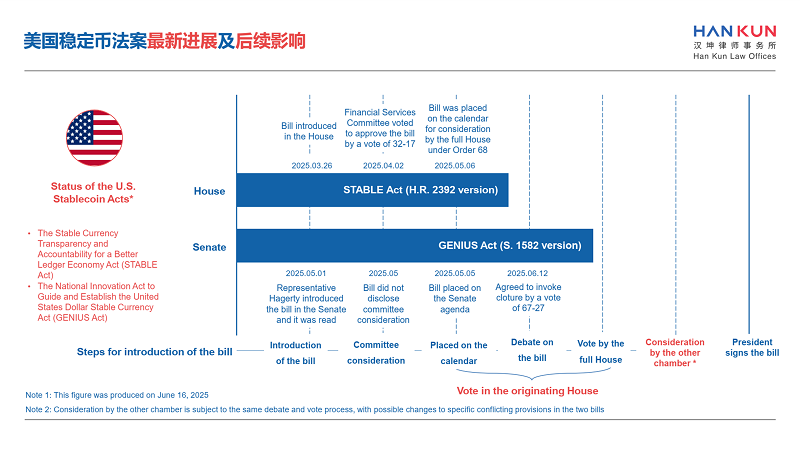
Given the pace and regulatory focus of the two bills, the GENIUS Act is likely to eventually pass both chambers of Congress as it better balances financial innovation and regulatory needs. Even if it passes the full Senate, however, the GENIUS Act will still go through the same process of debate and vote in the House of Representatives. So, the latest procedural vote victory for the GENIUS Act does not mean that it will eventually pass both chambers of Congress and become law.
In particular, the Democratic Party has levelled allegations that the Trump family has been using cryptocurrencies to unjustly enrich themselves, which has led to considerable uncertainty as to the future of both the GENIUS Act and the STABLE Act. A number of Democratic senators have already opposed the GENIUS Act on the grounds that cryptocurrency businesses are allegedly controlled by the Trump family, and an amended draft of the GENIUS Act was introduced to win Democratic support during the debate. Therefore, even if the GENIUS Act eventually passes both chambers of Congress, it remains unsettled how the conflicting provisions of the STABLE Act will be addressed before the bill may be signed into law.
Subsequent impact of the U.S. Stablecoin Acts
In the short run, both bills would provide much-needed regulatory certainty to the stablecoin market in the United States and around the world, especially given that the dominant stablecoins in the market are pegged to the value of the U.S. dollar. In turn, the U.S. Stablecoin Acts would facilitate wider adoption by institutional investors and pave the way for traditional financial institutions to enter the stablecoin market.
In the long run, the tiered regulatory system under the GENIUS Act is more likely to foster a diversified and differentiated stablecoin issuance ecosystem, while the more restrictive requirements under the STABLE Act may force small stablecoin issuers to face high compliance costs, which may result in the further concentration of the stablecoin market share in the hands of Tether and Circle, the two giants with a near-monopoly position in the global stablecoin market.
Regardless of which of the U.S. Stablecoin Acts is ultimately passed and signed into law, they represent a significant shift in the U.S. government's regulatory stance on cryptocurrencies. It also indicates that the United States is unwilling to forgo a historic opportunity to continue to consolidate the hegemony of the U.S. dollar. The eventual enactment of the U.S. Stablecoin Acts will undoubtedly continue to strengthen the dominant position of the U.S. dollar in the global stablecoin market and will have a significant impact on the existing international monetary system.
Therefore, stablecoins should no longer be considered an insignificant or niche area for enterprises interested in further expanding the scale of offshore trading and investment institutions focused on the fintech sector. Instead, stablecoins are expected to become an important factor in reshaping the existing cross-border payment pattern and directly affecting the cost of collection and payment of offshore capital for enterprises. Any party that plans to issue compliant stablecoins overseas or wishes to use stablecoins for payment and settlement in cross-border trade needs to pay attention to the ultimate development of the U.S. Stablecoin Acts and timely assess the impact of the stablecoin models on their business, so as to properly arrange their subsequent business plans.
Important Announcement |
|
This Legal Commentary has been prepared for clients and professional associates of Han Kun Law Offices. Whilst every effort has been made to ensure accuracy, no responsibility can be accepted for errors and omissions, however caused. The information contained in this publication should not be relied on as legal advice and should not be regarded as a substitute for detailed advice in individual cases. If you have any questions regarding this publication, please contact: |
|
Xun LI Tel: +86 21 6080 0232 Email: xun.li@hankunlaw.com |
[1]Wenxin Ruan has contributions to this article.


