Authors: Han CHEN丨Hao WU[1]
In our first article of this series Tax Compliance for Chinese Individuals Investing Overseas (Part I): Key Tax Considerations for Three Types of Investors, we introduced three typical categories of overseas investors: (1) entrepreneurs holding domestic and overseas assets through offshore holding structures; (2) multinational executives working cross-border and receiving remuneration in different jurisdictions; (3) globally mobile individuals who have relocated overseas while maintaining Chinese nationality and significant economic connections with China.
Although these investors differ significantly in terms of their personal background, investment activities and asset-holding structures, they share a common question in the CRS 2.0 era:
What offshore asset information can tax authorities actually access and analyze through CRS 2.0?
To explore this evolving transparency framework, we have divided our analysis into two parts:
(1) CRS 2.0, Understanding Your Overseas Wealth Structure
(2) Beyond CRS, The Beneficial Ownership Regime as a Parallel Transparency Framework
Why Did CRS Need to Evolve into CRS 2.0?
Since China first participated in the CRS automatic exchange of financial account information in September 2018, offshore financial account information has been continuously exchanged with Chinese tax authorities. Over the past several years, CRS has evolved beyond its initial stage of simply establishing an international information exchange mechanism. It has increasingly become an integral part of tax administrations' routine risk identification, data analysis and compliance enforcement processes.
In particular, since 2025, CRS information has been more extensively utilized in tax administration across China. The review of potential offshore income risks has gradually shifted from case-by-case investigations and pilot initiatives toward a more systematic and regularized compliance framework. For individuals holding offshore assets, CRS is no longer merely an international tax transparency standard; it has become an important source of information supporting tax risk assessment and enforcement by tax authorities.
However, nearly a decade of implementation has also revealed certain limitations of the first generation CRS framework (hereinafter referred to as "CRS 1.0").
Under CRS 1.0, tax authorities can obtain key financial account information, including account balances, interest income, dividend income and proceeds from the sale of financial assets. Nevertheless, in our experience advising on related matters, such information primarily provides an account-level view of offshore assets, while offering limited visibility into the underlying ownership structures, control relationships and legal arrangements behind those assets.
For example, tax authorities may have access to the value of assets held in an offshore account by a tax resident, but such information alone may not clearly reveal whether the assets represent deposits, securities, investment funds or other financial products. More importantly, it may remain difficult to determine whether the assets are held directly by an individual or indirectly through complex structures such as offshore companies, family trusts or other legal arrangements. Even where the ultimate controlling person can be identified, CRS 1.0 may not provide sufficient details regarding that person's precise role and relationship within the ownership structure.
These information gaps have limited, to some extent, the effectiveness of CRS information in tax risk assessment and anti-avoidance efforts. Where offshore assets are held through complex arrangements lacking genuine commercial purposes or sufficient tax rationale, the inability to identify the underlying control relationships and economic substance may increase the difficulty for tax authorities in conducting look-through analysis, determining the appropriate attribution of income and assessing the reasonableness of tax treatment.
Against this background, CRS 2.0 represents a significant evolution of the global tax transparency framework. Rather than merely expanding the volume of information exchanged, the revised framework aims to provide tax authorities with a more comprehensive understanding of the ownership, control and economic substance behind offshore financial assets.
What Has Changed Under CRS 2.0?
Against this background, the OECD released the Crypto-Asset Reporting Framework and 2023 Update to the Common Reporting Standard in 2023[2].
While maintaining the fundamental framework of the CRS, the 2023 Update introduced one of the most significant revisions in recent years, expanding the scope of reportable financial assets, strengthening financial institutions' due diligence obligations, and increasing the level of detail required in CRS reporting.
This article focuses solely on the amendments to the existing CRS framework (2023 Update to the Common Reporting Standard, hereinafter referred to as "CRS 2.0") and does not discuss the newly introduced Crypto-Asset Reporting Framework (CARF).
The key amendments under CRS 2.0 are summarized below:
Table 1: Key Amendments under OECD CRS 2.0
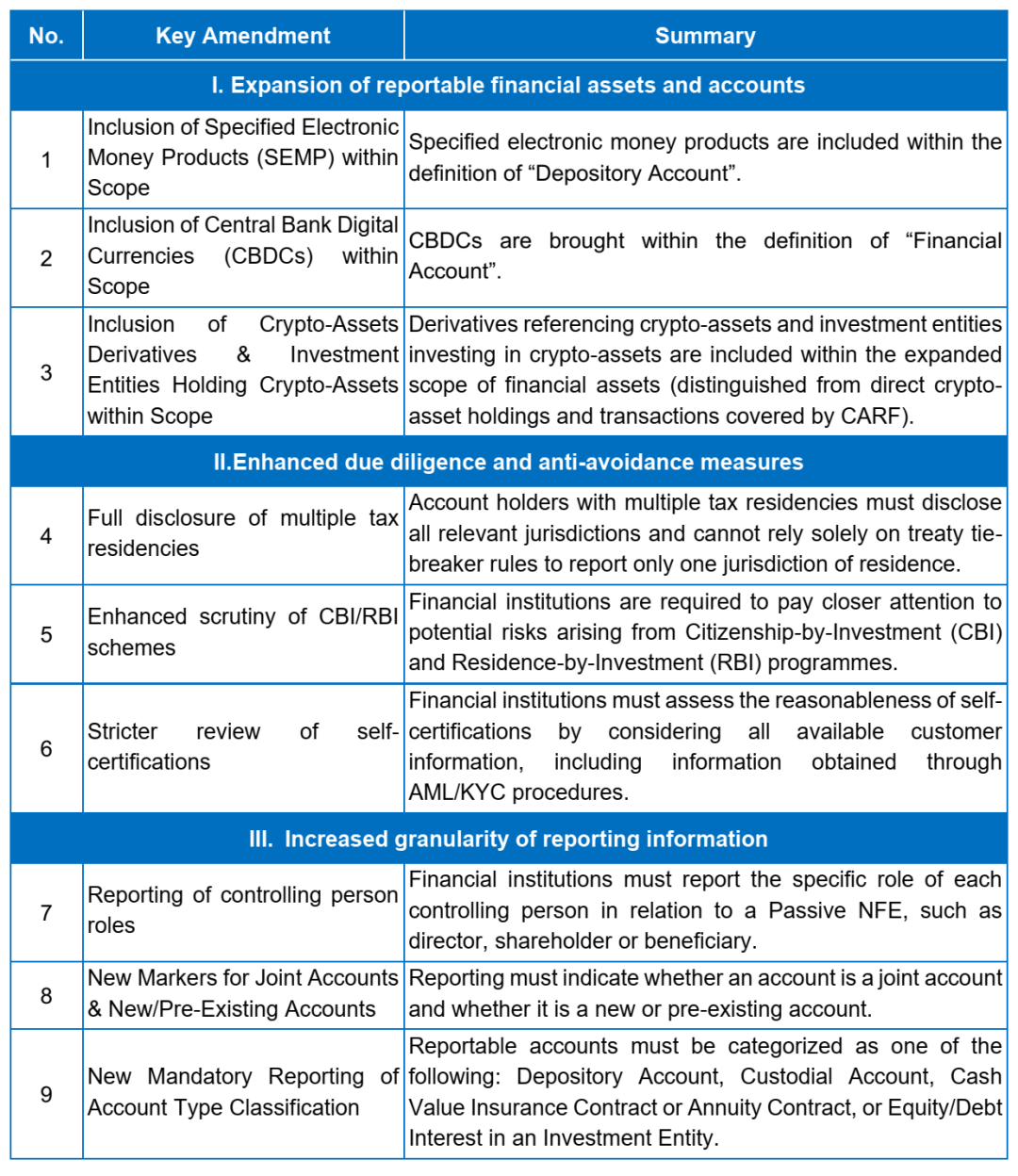
At first glance, CRS 2.0 may appear to be merely an expansion of reporting fields. However, its practical impact goes far beyond the addition of several new data points. One of the most important changes under CRS 2.0 is that the regulatory focus has shifted from simply "obtaining account information" to "verifying the reliability of reported information and understanding the control relationships behind financial assets."
During the implementation of CRS 1.0, some account holders treated tax residency self-certification as a purely procedural requirement: once the form was signed, the process was effectively completed. In practice, financial institutions often relied primarily on information provided by customers when conducting their reviews.
This approach created potential risks to CRS accuracy. For example, some individuals may have obtained tax identification numbers from certain jurisdictions through low-cost residency or tax number arrangements and subsequently represented themselves to financial institutions as tax residents of those jurisdictions, without fully disclosing their actual tax residency status.
CRS 2.0 directly addresses these risks by strengthening financial institutions' verification obligations. Where an account holder may have tax residency connections with multiple jurisdictions, financial institutions can no longer simply rely on treaty tie-breaker rules to identify a single jurisdiction of residence for CRS purposes. Instead, all relevant tax residency jurisdictions must be disclosed. Similarly, where citizenship-by-investment or residence-by-investment programmes may create risks of inaccurate tax residency declarations, financial institutions are expected to apply enhanced scrutiny. They must also assess the reasonableness of customer self-certifications by taking into account all available AML/KYC information, including passport details, residential addresses, telephone numbers, transaction patterns and other relevant customer information. Where inconsistencies arise, financial institutions may request further explanations or supporting documentation.
This means that arrangements previously relying on "identity documents + self-certification" to create information gaps are likely to face increasing scrutiny. Individuals who have obtained alternative residency status through immigration programmes, maintain cross-border living arrangements, or have potential multiple tax residencies should carefully reassess whether their existing tax residency analysis and CRS reporting positions remain sustainable.
Beyond tax residency identification, another fundamental change under CRS 2.0 is the increased structural granularity of exchanged information. The introduction of controlling person roles, account classifications and joint account indicators does not merely increase the volume of information exchanged. More importantly, it enables tax authorities to connect previously fragmented data points – including account information, ownership structures, legal relationships, control arrangements and tax residency information – and develop a more comprehensive understanding of offshore asset structures.
In the CRS 1.0 era, tax authorities primarily saw offshore financial account data. In the CRS 2.0 era, with enhanced information on controlling persons, account types and ownership relationships, tax authorities will increasingly be able to identify the structures, control relationships and tax residency profiles behind offshore assets.
In other words, CRS is evolving from "account transparency" to "structural transparency." At the same time, CRS 2.0 strengthens the ability of tax authorities and financial institutions to cross-check information from multiple sources. The room for relying on identity documents, self-certifications or fragmented structural arrangements to maintain information asymmetry is narrowing. In the CRS 2.0 era, the long-term sustainability of offshore structures will increasingly depend on whether the underlying details – often overlooked in the past – are properly aligned.
Why CRS Compliance Outcomes Depend on Local Legal Frameworks and Regulatory Practices
According to the latest data released by the OECD on 3 July 2026, 77 jurisdictions have committed to implementing CRS 2.0[3]. These jurisdictions are expected to complete the necessary domestic legislative processes over the next three years and conduct their first exchanges of information under the amended CRS framework.
It is important to note, however, that the OECD CRS framework represents an internationally agreed standard rather than directly applicable domestic law. Each jurisdiction must translate the CRS 2.0 requirements into its own legal and regulatory framework through domestic legislation, administrative guidance, and supervisory practices.
As a result, while CRS 2.0 establishes a common global standard, its practical implementation will inevitably vary across jurisdictions. Differences may arise in areas such as legislative timelines, regulatory priorities, enforcement approaches, and the level of scrutiny applied by local authorities.
For financial institutions and investors, the future CRS compliance landscape will therefore be shaped by a combination of a unified OECD standard and jurisdiction-specific implementation rules. Understanding not only the CRS 2.0 requirements themselves, but also the local legal framework and regulatory practices of the relevant financial centre, will become increasingly important for effective cross-border tax compliance management.
Figure 1: Steps for the implementation of CRS 2.0 in different jurisdictions

Table 2: CRS 2.0 Implementation Status Across in Key Financial Jurisdictions
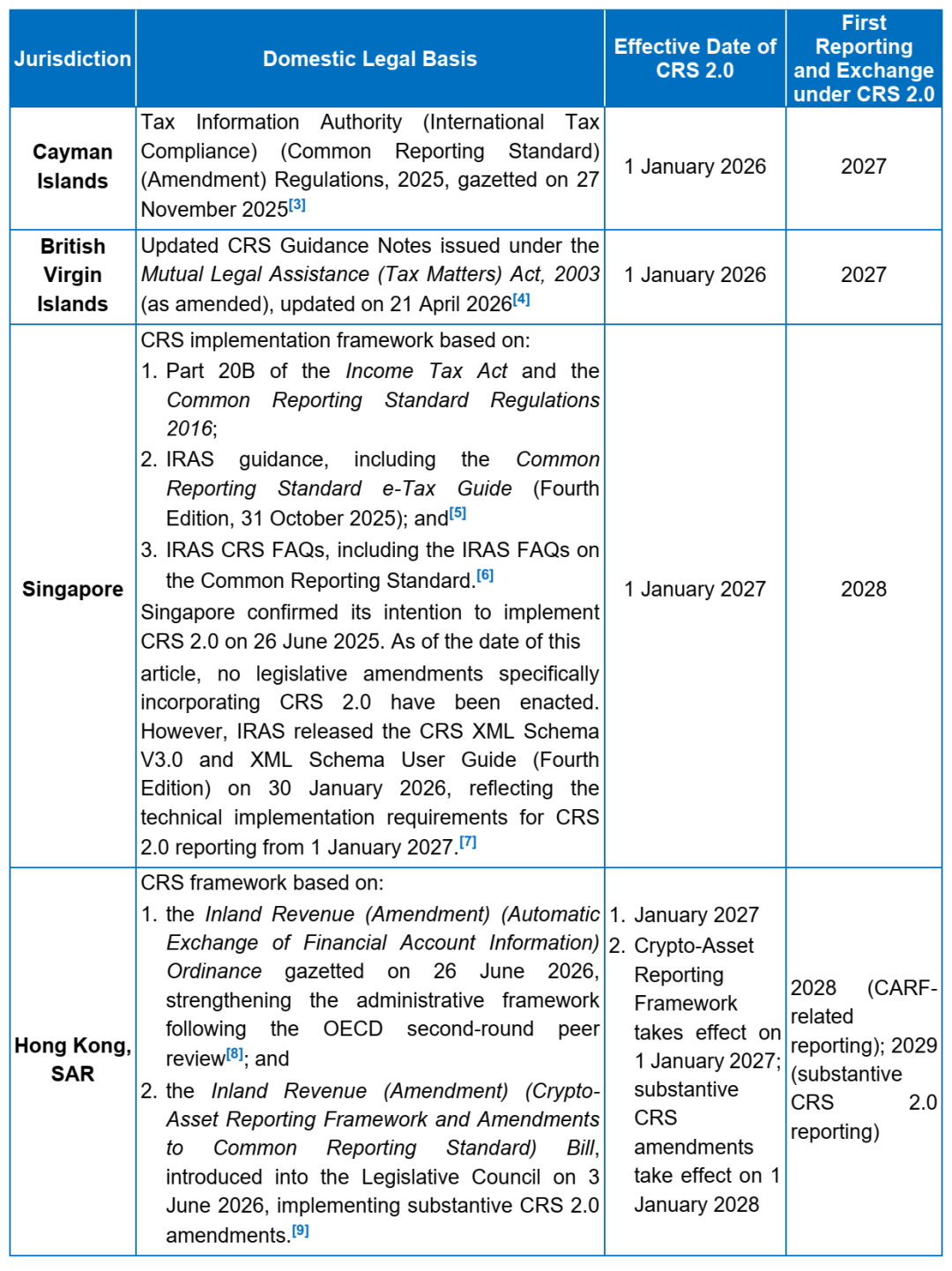
The practical implementation of CRS cannot be assessed solely by reviewing the applicable legislation. A meaningful analysis requires consideration of three interconnected factors: the legal framework, regulatory enforcement, and the compliance practices adopted by financial institutions.
Taking the Cayman Islands, the British Virgin Islands (BVI), Singapore and Hong Kong SAR as examples, significant differences can be observed despite these jurisdictions all implementing the CRS framework.
First, from a legislative perspective, all four jurisdictions have established penalty regimes addressing failures to comply with due diligence obligations, reporting requirements and information accuracy obligations. However, the design and level of detail of these regimes vary.
The Cayman Islands and the BVI generally adopt more granular penalty structures, with different sanctions applying to different types of non-compliance and, in certain circumstances, criminal liability being available. Their legislation provides relatively detailed compliance obligations and enforcement consequences.
By contrast, Singapore and Hong Kong SAR primarily rely on administrative penalties and ongoing regulatory supervision. Their legislative provisions are comparatively concise, with greater emphasis placed on regulatory oversight, compliance reviews and internal control mechanisms to ensure that financial institutions fulfil their CRS obligations.
Second, from a regulatory enforcement perspective, Singapore and Hong Kong SAR benefit from mature financial regulatory systems and have consistently adopted risk-based supervision and compliance monitoring approaches. Their enforcement environment is generally viewed as stable and robust.
The Cayman Islands has also strengthened its enforcement efforts in recent years, partly driven by international peer review processes and increasing expectations regarding effective implementation of international tax transparency standards.
Third, from the perspective of individual investors, the most immediate impact is often reflected in financial institutions' compliance requirements.
The BVI has continued to enhance its regulatory framework; however, questions regarding the frequency of enforcement actions, depth of compliance reviews and practical effectiveness of supervision remain areas subject to ongoing international assessment.
Third, from the perspective of individual investors, the most immediate impact is often reflected in financial institutions' compliance requirements.
In jurisdictions with more mature regulatory systems and stricter enforcement environments, financial institutions are generally more likely to adopt a conservative risk management approach. During account opening procedures, ongoing due diligence reviews and tax residency verification processes, clients may be required to provide more comprehensive supporting documentation.
Financial institutions may also conduct more detailed reviews of complex ownership structures, trust arrangements and potential multiple tax residency situations to ensure the accuracy and reliability of CRS reporting.
Therefore, understanding CRS requires more than simply reviewing statutory provisions or regulatory texts. The key question is how these rules operate in practice – including how regulators interpret and enforce the framework, how financial institutions apply compliance standards, and how industry practices shape the actual CRS experience faced by investors.
IV CRS 2.0: What Does It Mean for Individual Investors?
For the three typical investor profiles discussed in our previous article Tax Compliance for Chinese Individuals Investing Overseas (Part I): Key Tax Considerations for Three Types of Investors, the impact of CRS 2.0 goes far beyond the simple fact that "more information will be reported." The more fundamental change is that CRS 2.0 represents a shift in how tax authorities identify and analyze cross-border assets.
I. Entrepreneur Mr. A: Offshore Companies, Family Trusts and Private Investment Structures
For entrepreneurs holding offshore assets through offshore companies, family trusts or private investment companies, the key issue is no longer merely the name under which an account is registered.
Instead, greater attention will be placed on how financial institutions identify the controlling persons, ownership relationships and legal nature of these arrangements.
Under CRS 2.0, enhanced reporting fields and greater transparency regarding controlling persons may allow tax authorities to better understand the relationship between nominal ownership and actual control. Structures that previously appeared complex or opaque may become increasingly transparent through the combination of account information, ownership data and control relationship reporting.
II. Cross-Border Executive Ms. B: Tax Residency, Employment Income and Personal Reporting Consistency
For cross-border executives, CRS 2.0 places greater emphasis on the consistency between tax residency status, self-certification information and financial account records.
The alignment between cross-border employment income, equity incentives, offshore account income and individual income tax filings may become an increasingly important factor in future tax risk analysis.
Any inconsistency between tax residency positions or information reported across different jurisdictions may increase the likelihood of further review.
III. Global Investor Mr. C: Integrated Visibility of Global Wealth Structures
For individuals who have already established diversified global asset portfolios, family offices, offshore securities accounts, insurance policies and other financial assets will no longer be viewed as isolated pieces of information.
With greater transparency regarding account relationships, controlling persons and beneficiary arrangements, different components of an individual's wealth structure may increasingly be analyzed together, allowing tax authorities to develop a more comprehensive view of an individual's and family's global asset profile.
IV. Practical Steps for Offshore Investors
Before CRS 2.0 is fully implemented, offshore investors should consider taking the following steps:
1. Conduct a comprehensive review of existing offshore assets
Review offshore assets held through banks, trust companies, insurance companies, securities institutions and other reporting financial institutions, and assess how CRS 2.0 may affect their reporting obligations and compliance procedures.
2. Review existing self-certifications and tax residency information
Reassess existing self-certification forms, tax residency positions and account information to ensure that all relevant information remains accurate, complete and internally consistent.
3. Evaluate ownership structures and beneficiary arrangements
For assets held through offshore companies, trusts or other legal arrangements, investors should proactively assess whether controlling relationships, beneficiary arrangements and tax reporting positions remain properly aligned.
4. Plan compliance arrangements based on different implementation timelines
For families with assets located across jurisdictions implementing CRS 2.0 on different timelines, proactive planning will become increasingly important to avoid reactive adjustments after information exchange begins.
In the CRS 2.0 era, offshore investors need to manage more than whether a particular item of offshore income has been properly reported. The more fundamental question is whether their entire global asset structure has:
a clear ownership rationale;
a sustainable tax residency position; and
consistent reporting records across jurisdictions.
Cross-border wealth arrangements are highly interconnected. A weakness in one part of the structure may trigger broader tax consequences across multiple areas.
For individual investors, the era of relying on isolated solutions or one-off fixes is coming to an end. Offshore asset tax compliance should instead be viewed as a long-term and integrated management process requiring coordinated consideration of legal structures, tax positions and practical financial industry requirements.
Important Announcement |
|
This Legal Commentary has been prepared for clients and professional associates of Han Kun Law Offices. Whilst every effort has been made to ensure accuracy, no responsibility can be accepted for errors and omissions, however caused. The information contained in this publication should not be relied on as legal advice and should not be regarded as a substitute for detailed advice in individual cases. If you have any questions regarding this publication, please contact: |
|
Han CHEN Tel: +86 10 8525 4683 Email: han.chen@hankunlaw.com |
|
Hao WU Tel: +86 21 6016 9728 Email: hao.wu@hankunlaw.com |
[1]Lianjie Huang has contributions to this article.
[2] OECD, Crypto-Asset Reporting Framework and 2023 Update to the Common Reporting Standard, https://www.oecd.org/content/dam/oecd/en/publications/reports/2023/06/international-standards-for-automatic-exchange-of-information-in-tax-matters_ab3a23bc/896d79d1-en.pdf.
[3] OECD, Signatories of the Addendum to the Multilateral Competent Authority Agreement on Automatic Exchange of Financial Account Information Addendum to the CRS-MCAA, https://www.oecd.org/content/dam/oecd/en/topics/policy-issues/tax-transparency-and-international-co-operation/addendum-crs-mcaa-signatories.pdf.
[4] Cayman Islands, CRS Rules:https://www.ditc.ky/frameworks/crs/.
[5] BVI, CRS and CARF:https://bviita.vg/blog/2025/10/23/crs-2-0-and-carf/.
[6] IRAS, Common Reporting Standard e-Tax Guide, Fourth Edition (31 October 2025), https://www.iras.gov.sg/docs/default-source/e-tax/iras-common-reporting-standard_e-tax-guide-2.pdf?sfvrsn=58627c6a_46.
[7] IRAS, IRAS FAQs on the Common Reporting Standard, https://www.iras.gov.sg/docs/default-source/uploadedfiles/pdf/iras-faqs-on-the-common-reporting-standard-(23-oct-2021).pdf?sfvrsn=d955cd6b_11.
[8] Inland Revenue (Amendment) (Automatic Exchange of Information) Ordinance 2026, https://www.ird.gov.hk/eng/tax/aeoi/ordinance_2026.htm.
[9] Inland Revenue (Amendment) (Automatic Exchange of Information) Ordinance 2026, https://www.ird.gov.hk/eng/tax/aeoi/ordinance_2026.htm.
[10] Inland Revenue (Amendment) (Crypto-Asset Reporting Framework and Amended Common Reporting Standard) Bill 2026, https://www.ird.gov.hk/eng/tax/aeoi/crs_bill_2026.htm.


