Authors: Han CHEN丨Hao WU[1]
In our previous article, "Tax Compliance for Chinese Individuals Investing Overseas (Part II): CRS 2.0, Understanding Your Overseas Wealth Structure", we introduced how tax authorities are leveraging CRS 2.0 to gain greater visibility into the offshore wealth structures of individual investors. While the Common Reporting Standard (CRS) has become widely recognized, it is not the only regulatory tool being deployed. In parallel, global corporate transparency reforms are also advancing rapidly, introducing additional mechanisms that enhance authorities' ability to identify the ownership and control structures of offshore entities:
Company shareholder and director disclosure regimes: identifying who legally owns and manages an offshore company
Beneficial ownership registration regimes: revealing who ultimately controls the company and enjoys the underlying economic benefits
What Are the Changes Brought by Company Shareholder and Director Disclosure Regimes/Beneficial Ownership Registration Regimes?
Offshore Company Shareholder and Director Disclosure Regimes
In China, obtaining basic information about a company is relatively straightforward. Through the National Enterprise Credit Information Publicity System, or commercial databases such as Qichacha and Tianyancha, the public can generally access information including a company's registered capital, shareholders, legal representatives, directors, and changes in ownership structure. However, in many offshore jurisdictions, accessing information on a company's shareholders and directors has historically been more challenging. Unlike China, many jurisdictions do not maintain a publicly accessible corporate information database that provides comprehensive company ownership details.
In recent years, major global financial centers have generally strengthened their corporate transparency requirements:
International financial centers such as Hong Kong SAR and Singapore established relatively comprehensive company registration and information disclosure systems at an early stage. Both the public and regulatory authorities can more readily access basic company information, including shareholder and director details;
Traditional offshore financial centers such as the British Virgin Islands (BVI) and the Cayman Islands historically placed greater emphasis on commercial privacy and convenience. However, driven by evolving international anti-money laundering (AML) standards and increasing regulatory expectations, these jurisdictions have continuously enhanced requirements for maintaining corporate records and providing access to competent authorities.
This global trend indicates that offshore companies are no longer completely closed information silos, and shareholding arrangements, directorships, and corporate control relationships are increasingly being brought within the scope of regulatory oversight. At present, there are generally three main models for accessing corporate information globally:
Public Disclosure Model |
An increasing number of jurisdictions have established public corporate information disclosure regimes, although access to certain information may require payment. For example, the United Kingdom, Hong Kong SAR, Singapore, and various European jurisdictions such as Germany have developed relatively comprehensive company registration and information access systems. Through official channels, the public can generally obtain a company's basic registration information. Director information is often relatively accessible, while the availability of shareholder information varies depending on the jurisdiction and the type of company. In some jurisdictions, shareholder information can be directly accessed; in others, users may need to purchase company filings, corporate profiles, or official registration documents to obtain more detailed information. Unlike China's enterprise information disclosure system, offshore corporate information access regimes generally follow a "basic information publicly available, detailed information available upon payment" approach. Not all registered information is freely accessible to the public. |
Limited Disclosure Model |
Some jurisdictions adopt a limited disclosure model, under which corporate information may be accessible upon payment through registered agents or professional service providers. For example, jurisdictions such as the British Virgin Islands (BVI) and the Cayman Islands require companies to maintain a Register of Directors and a Register of Members and to retain relevant information within the applicable regulatory framework. However, these jurisdictions have not established comprehensive public corporate information search systems comparable to those in the United Kingdom or Hong Kong SAR. Relevant information is primarily maintained by the company itself, its registered agent, and competent authorities. The public generally cannot obtain complete shareholder and director information through free searches of official databases. Nevertheless, in scenarios such as commercial due diligence, financial institution onboarding, and transaction arrangements, relevant parties may obtain certain corporate information through the company, registered agents, or professional service providers, subject to applicable procedures and requirements. |
Non-Public Disclosure Model |
A limited number of jurisdictions have established company registration regimes but do not provide a public corporate information search mechanism. For example, in certain U.S. states, such as Delaware, companies are required to complete incorporation filings and maintain certain corporate records including information relating to the registered agents, directors, and officers. However, such information is generally not available for public inspection. Shareholder information is typically maintained internally by the company. As a result, external parties are generally unable to determine a company's complete ownership structure through government public databases. Instead, access to such information typically depends on counterparty disclosure, commercial due diligence processes, regulatory requests, or judicial proceedings. |
Based on our observations in practice, with the continued enhancement of offshore corporate registration and information disclosure mechanisms, regulatory authorities in China have increasingly gained access to shareholder, director, and other corporate registration details of offshore companies through various information channels. These corporate records are now being utilized as an important source of information for cross-border investment reviews, tax avoidance risk analysis, and regulatory compliance assessments.
Offshore Company Beneficial Ownership Registration Regimes
Traditional corporate registration systems have an inherent limitation: they generally reflect only the legal ownership and management structure of a company, but may not reveal the underlying individuals who ultimately control the entity or enjoy its economic benefits.
For example, from a corporate registration perspective, a company may be legally owned by another corporate entity, while its directors may be appointed through professional service providers or nominee arrangements. The individuals who actually control the company may be concealed behind multiple layers of companies, trusts, partnerships, or other legal structures. Historically, due to the fragmentation of corporate information across different jurisdictions, regulatory authorities often faced challenges in identifying the true ownership and control relationships behind complex cross-border structures based solely on a single source of information.
Against this background, regulators have increasingly recognized that relying solely on traditional shareholder and director disclosure regimes is no longer sufficient to meet the requirements of anti-money laundering (AML), anti-corruption initiatives, international tax transparency, and cross-border regulatory cooperation. What regulators seek to identify is not merely who legally holds shares in a company or who is appointed as its director, but more importantly, who ultimately owns or controls the legal entity and who ultimately benefits from its economic value. This has led to the development and implementation of beneficial ownership registration regimes.
I. What Is a Beneficial Ownership Registration Regime?
A beneficial owner generally refers to the natural person who ultimately owns or controls a legal entity, or who ultimately enjoys the economic benefits derived from that entity. Unlike shareholders recorded in corporate registration regimes, beneficial ownership registration regimes do not focus solely on formal shareholding arrangements. Instead, they seek to look through legal structures to identify the ultimate beneficial owner (UBO) — namely, the individual who ultimately exercises control over the entity or receives the underlying economic benefits.
For example, an individual in China may hold offshore investment assets through a structure involving a BVI company and a Hong Kong company. From a legal ownership perspective, the assets may be owned by the offshore entities. However, the key questions for regulatory authorities are: Who ultimately controls these entities? Who ultimately enjoys the economic benefits generated by the underlying assets?
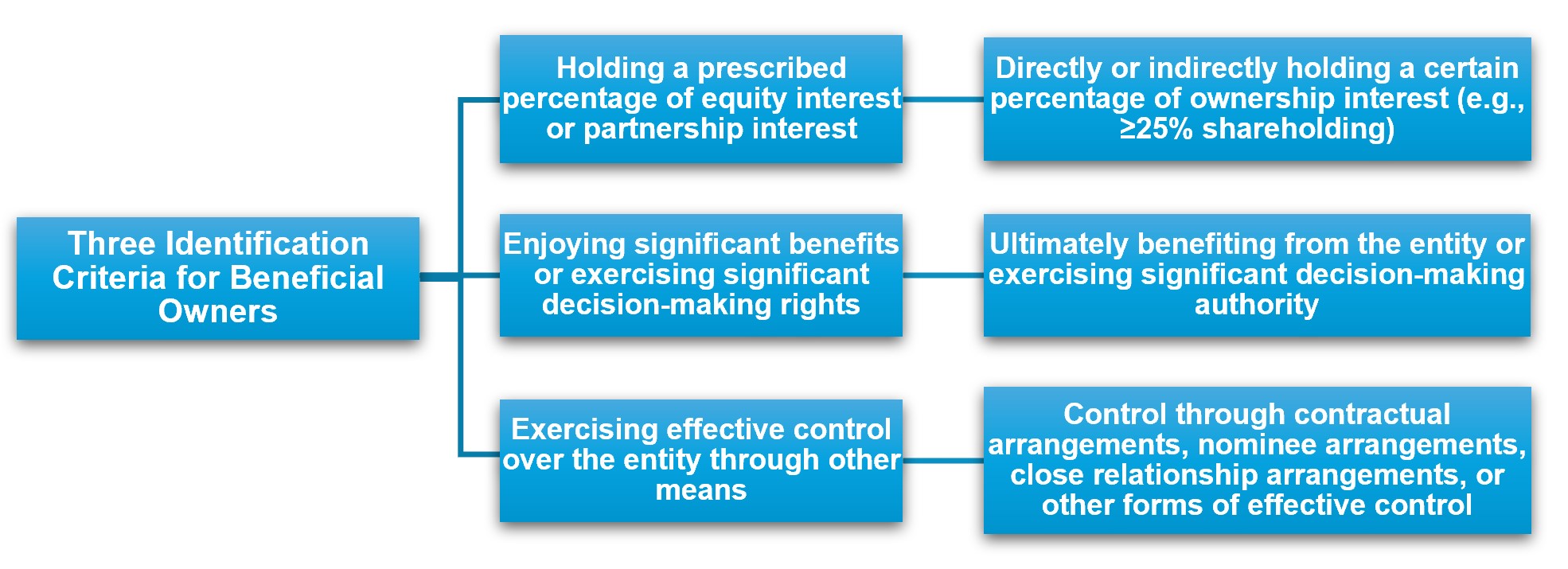
The concept of Beneficial Ownership Registration Regimes originated primarily from the global anti-money laundering (AML) regulatory framework. In 2003, the Financial Action Task Force (FATF) formally introduced the concept of beneficial ownership into its international AML standards. Subsequently, in 2012, FATF revised its FATF Recommendations, further strengthening transparency requirements for legal entities and legal arrangements. The fundamental objective of FATF's promotion of beneficial ownership registration regimes is to prevent the misuse of shell companies, nominee arrangements, and complex legal structures to conceal the true controller, so as to enable regulators to identify the actual control relationships behind legal entities.
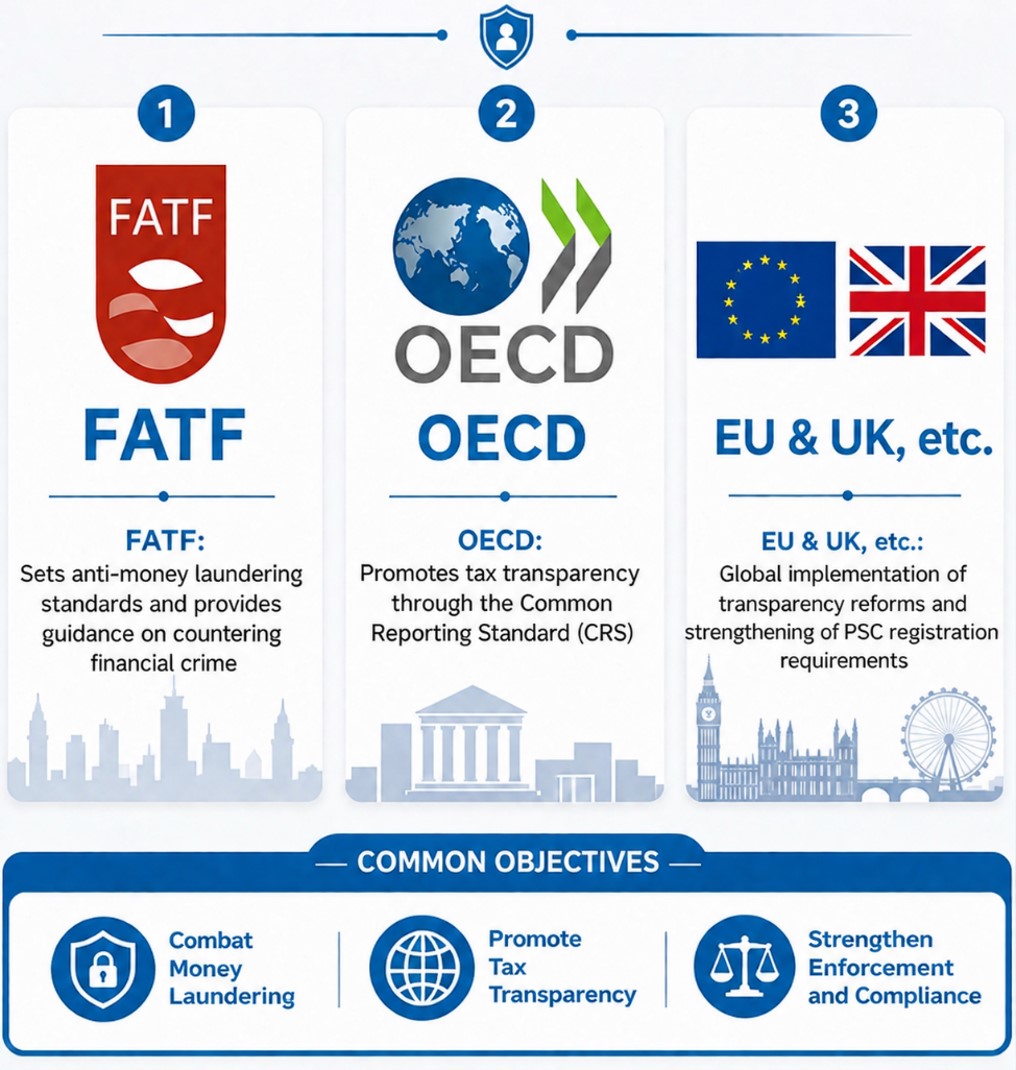
Following the release and widespread implementation of the Common Reporting Standard (CRS) by the Organisation for Economic Co-operation and Development (OECD) in 2014, the international community gradually recognized that financial account information alone was insufficient to provide a complete picture of complex cross-border asset structures:Tax authorities may be aware that a particular offshore financial account holds assets of a certain value. However, where the account is held through offshore companies, family trusts, nominee arrangements, or other legal structures, account information alone may not enable authorities to accurately determine the ultimate ownership of the assets; the underlying control relationships; and the identity of the ultimate beneficiaries. As a result, the OECD Global Forum on Transparency and Exchange of Information for Tax Purposes (Global Forum) incorporated beneficial ownership transparency into international tax transparency standards, which requires jurisdictions to ensure that their competent authorities are able to obtain beneficial ownership information relating to legal entities and legal arrangements.
Following the gradual establishment of international standards, jurisdictions around the world have progressively introduced domestic legislative frameworks to establish mechanisms for the collection, registration, and access of beneficial ownership information:
The European Union introduced the Fourth Anti-Money Laundering Directive (4AMLD) in 2015, which for the first time required Member States to establish beneficial ownership registration regimes. Subsequently, the Fifth Anti-Money Laundering Directive (5AMLD) adopted in 2018 further enhanced transparency requirements for beneficial ownership information and expanded the scope of access for competent authorities and other relevant parties;
The United Kingdom established the Persons with Significant Control (PSC) regime in 2016, requiring companies to identify and disclose individuals who exercise significant control over the company. The PSC regime made the UK one of the earlier major financial centers globally to introduce a public beneficial ownership disclosure mechanism;
The British Virgin Islands (BVI) established the Beneficial Ownership Secure Search System (BOSS) in 2017, requiring registered agents to collect and maintain beneficial ownership information of companies and allowing competent authorities to access such information under specified circumstances;
Singapore introduced the Register of Registrable Controllers (RORC) regime in 2017, requiring companies, foreign companies, and limited liability partnerships to identify and maintain information relating to their registrable controllers;
Hong Kong SAR implemented the Significant Controllers Register (SCR) regime under the Companies Ordinance in 2018, requiring Hong Kong companies to maintain information relating to their significant controllers and provide access to such information when required for law enforcement purposes;
China formally implemented the Administrative Measures for Beneficial Ownership Information (《受益所有人信息管理办法》) in 2024, establishing a nationwide beneficial ownership information management framework. The measures require relevant entities to file beneficial ownership information with registration authorities, providing an institutional foundation for regulatory authorities to conduct risk identification and information inquiries.
II. How Do Regulatory Authorities Obtain Beneficial Ownership Information of Offshore Companies?
It is important to note that beneficial ownership information of offshore companies is generally not directly available to regulatory authorities in other jurisdictions. For foreign regulatory authorities, access to such information typically relies on access mechanisms permitted under local laws, or is achieved through channels such as tax information exchange and cross-border regulatory cooperation.
1. Obtaining Information Through International Tax and Regulatory Cooperation Mechanisms
For the purposes of cross-border tax risk management, tax information exchange represents an important channel for obtaining information regarding the ownership and control structures of offshore entities. Currently, jurisdictions primarily rely on the following international cooperation mechanisms:
Exchange of Information Article under bilateral tax treaties (Exchange of Information Article);
Tax Information Exchange Agreements (TIEAs);
Multilateral Convention on Mutual Administrative Assistance in Tax Matters.
For example, according to publicly available information from the State Taxation Administration of China, as of the end of July 2025, China had formally signed agreements and arrangements relating to the avoidance of double taxation and other tax matters with 114 jurisdictions, most of which contain Exchange of Information Articles. In addition, China has entered into Tax Information Exchange Agreements (TIEAs) with 10 jurisdictions, including commonly used offshore financial centers such as the British Virgin Islands (BVI), Cayman Islands, Jersey, Guernsey, Bahamas, Bermuda, and Liechtenstein.
Where the relevant legal requirements and treaty provisions are satisfied, Chinese tax authorities may submit information requests to the competent tax authorities of relevant jurisdictions through tax information exchange mechanisms. Such requests may enable access to offshore company registration records, beneficial ownership information, and other information relevant to tax administration that is held by foreign tax authorities or other competent authorities. This mechanism provides an important source of information for Chinese tax authorities to identify the ultimate control relationships behind offshore entities and conduct cross-border tax risk analysis.
2. Obtaining Information Through Local Beneficial Ownership Registration Systems
Beneficial Ownership Registration Regimes differ significantly from traditional Company Shareholder and Director Disclosure Regimes. In most jurisdictions, beneficial ownership information is not made fully available to the public. Instead, such information is primarily accessible by local regulatory authorities, law enforcement agencies, and competent authorities when performing their regulatory functions. Therefore, beneficial ownership information is generally considered "available to regulators" rather than "freely accessible to the public."
Currently, only a limited number of jurisdictions have established restricted access mechanisms for non-regulatory parties. For example, the Cayman Islands has introduced the Legitimate Interest Access Framework, which allows eligible applicants to access certain beneficial ownership information based on a legitimate interest. Eligible applicants may include parties involved in commercial transactions, investigative journalists, and academic researchers. Although this framework was not specifically designed for foreign regulatory authorities, subject to compliance with local legal requirements, relevant parties may potentially obtain certain information through lawful channels for purposes such as commercial due diligence, risk assessment, or other legitimate purposes.
III. Why Does the Beneficial Ownership Registration Regime Matter?--Regulatory Authorities Are Building Multi-Dimensional Look-Through Capabilities
The value of beneficial ownership information lies in providing regulatory authorities with a fundamental source of information for identifying ultimate control relationships. This enables authorities to further analyze:
the individuals who ultimately control multi-layer offshore corporate structures;
the underlying beneficial interests behind arrangements such as trusts and nominee structures;
whether different offshore entities are connected through ownership or control relationships; and
whether cross-border investments and transaction arrangements have genuine commercial purposes.
More importantly, beneficial ownership information does not operate independently. Instead, it interacts with CRS, offshore investment regulatory frameworks, foreign exchange administration systems, and tax administration mechanisms, enabling regulatory authorities to conduct cross-verification across multiple information sources and develop more comprehensive look-through capabilities.
1. Tax Regulation: Identifying Ultimate Control Relationships and Determining Income Attribution and Transaction Substance
In the field of taxation, the significance of Beneficial Ownership Registration Regimes lies in enabling tax authorities to move beyond reliance solely on legal form and more accurately identify the ultimate control relationships behind offshore entities. By combining beneficial ownership information with income sources, transaction arrangements, and other tax reporting information, tax authorities can conduct a comprehensive assessment of cross-border tax matters.
In complex cross-border structures, offshore companies, funds, or other legal entities may serve as formal investment vehicles or transaction counterparties. However, the ultimate controllers, beneficial owners, and relationships between these entities and domestic parties may not be readily identifiable through traditional shareholder and director registration information.
Beneficial ownership information may assist tax authorities in various regulatory scenarios, including:
Related-Party Transaction Management: assisting in determining whether domestic and offshore entities are subject to actual control relationships;
Offshore Income Management: assisting in analyzing the ultimate attribution of relevant income and identifying the actual beneficiaries;
Complex Wealth Structures: assisting in identifying economic relationships among different legal arrangements, including companies, trusts, and funds.
For example, assume a China resident individual establishes a trading company in Hong Kong SAR. The company conducts genuine business operations and may therefore qualify as an Active Non-Financial Entity (Active NFE) under the Common Reporting Standard (CRS) framework. As a result, its financial accounts may not be subject to automatic exchange of information in the same manner as accounts held by financial institutions. At the same time, assume that the individual has not completed the required offshore investment registration or foreign exchange compliance procedures.
If the Hong Kong company conducts continuous trading transactions with related domestic enterprises, but the transaction prices deviate significantly from the arm's length principle, tax authorities, when conducting a related-party transaction review, may combine offshore company registration records;shareholder and director information;beneficial ownership information; and domestic enterprise tax filings to identify the ultimate controller of the Hong Kong company. Based on such analysis, tax authorities may determine whether the parties constitute related parties and further assess whether the transaction arrangements comply with the arm's length principle.
2. Offshore Investment and Foreign Exchange Regulation: Identifying the True Investment Parties and Control Chains
The Regulations of the State Council on Outbound Investment (《国务院关于对外投资的规定》, State Council Order No. 837) explicitly brings individual overseas investment activities within the scope of regulatory oversight. Article 2 of Order No. 837 defines overseas investment as activities through which an investor:"directly or indirectly obtains ownership, control, operational management rights, or other relevant interests in enterprises or assets located in other countries or regions through investment of assets, equity interests, or through financing, guarantees, or other means."
This raises an important question: How can regulatory authorities obtain information regarding such investment activities?
In practice, China had already established relevant regulatory frameworks for overseas investment and cross-border capital movements before the introduction of Oeder No. 837, including:
Where China resident individuals conduct offshore financing or investment activities through Special Purpose Vehicles (SPVs), they are required to comply with registration requirements under the Circular of the SAFE on Foreign Exchange Administration of Overseas Investments and Financing and Round-Trip Investments by Domestic Residents via Special Purpose Vehicles (Huifa No. 37 [2014]);
Outbound Direct Investment (ODI) generally requires filing or approval procedures with relevant authorities, including the National Development and Reform Commission (NDRC),the Ministry of Commerce (MOFCOM), and the State Administration of Foreign Exchange(SAFE), in accordance with applicable regulations;
Where resident enterprises or domestic partnerships directly or indirectly hold 10% or more (including 10%) of shares or voting rights in a foreign enterprise, they are required to submit the Report Form on Overseas Investment Information of Resident Enterprises to the competent tax authorities in accordance with the provisions of the Announcement of the State Taxation Administration on Optimizing Tax Payment Services and Streamlining and Consolidating Relevant Statements for Resident Enterprises to Report Overseas Investment and Income Information (Announcement No. 17 of 2023 of the State Taxation Administration).
These regulatory mechanisms are based on an important assumption: that investors will proactively and fully disclose their offshore investment structures, ownership arrangements, and related transaction information in accordance with regulatory requirements. However, in practice, certain offshore investment or ownership arrangements may not be properly registered or reported as required. In addition, some investors may hold offshore assets through multi-layer offshore corporate structures; nominee arrangements; or trust structures, making the underlying control relationships more complex and difficult for regulators to identify.
Against this background, beneficial ownership registration regimes provide an important supplementary source of information. Through beneficial ownership registration systems established in offshore jurisdictions, regulatory authorities may, under applicable conditions, obtain information regarding the individuals who ultimately control offshore entities. Such information can then be cross-checked against existing domestic records, including: foreign exchange registration information; offshore investment filing records; tax reporting information; and cross-border capital flow data.
Recommendations for Individual Investors
With the continued development of beneficial ownership registration regimes, international tax information exchange mechanisms, and cross-border regulatory cooperation frameworks, the ultimate control relationships, investment structures, and related transaction arrangements behind offshore entities are increasingly becoming accessible to regulatory authorities. The information gap surrounding offshore structures is gradually narrowing.
In an era of enhanced transparency driven by CRS, beneficial ownership registration regimes, and global tax transparency initiatives, investors such as Mr. A and Mr. C, who have established complex offshore structures, offshore company ownership arrangements, or multi-layer investment structures, should consider conducting a systematic legal and compliance health check of their existing arrangements:
A. Conducting a comprehensive review of offshore companies, investment funds, trusts, family offices, and other legal entities, including their ownership structures, shareholding arrangements, and control relationships;
B. Verifying whether historical offshore investments, foreign exchange registrations, tax filings, and other regulatory compliance matters have been properly completed and remain consistent;
C. Reassessing the commercial rationale and compliance foundation of existing structures in light of evolving regulatory requirements and global transparency trends;
D. Conducting timely risk assessments and developing remediation plans for historical compliance gaps or incomplete regulatory procedures.
For complex cross-border asset arrangements, details often determine the overall outcome. A seemingly simple offshore holding structure may involve challenges far beyond understanding a single regulation or compliance requirement. The key issue is whether the investor can, from multiple perspectives including legal relationships, tax treatment, and regulatory compliance, reconstruct and substantiate the consistency of the investment pathway; ownership changes; fund flows; control relationships; and domestic and offshore reporting obligations. Ultimately, complex offshore arrangements must be able to withstand comprehensive review under multiple regulatory frameworks and demonstrate consistency, transparency, and compliance across jurisdictions.
Important Announcement |
|
This Legal Commentary has been prepared for clients and professional associates of Han Kun Law Offices. Whilst every effort has been made to ensure accuracy, no responsibility can be accepted for errors and omissions, however caused. The information contained in this publication should not be relied on as legal advice and should not be regarded as a substitute for detailed advice in individual cases. If you have any questions regarding this publication, please contact: |
|
Han CHEN Tel: +86 10 8525 4683 Email: han.chen@hankunlaw.com |
|
Hao WU Tel: +86 21 6016 9728 Email: hao.wu@hankunlaw.com |
[1]Lianjie Huang has contributions to this article.


